Tell Me a Place
A voice-first memory map: you describe a place you’ve lived out loud, through the senses, and a machine tries to locate it.
- ROLE
- AI Experience Designer
- YEAR
- October 2026
- TYPE
- Self-initiated lab experiment
- STATUS
- Dead end
Voice works best in its own tab (Chrome or Safari). Inside this page some browsers block the microphone; the keyboard button lets you type instead.
Overview
Tell me a place revisits my master’s project, a memory map connecting Lima and Manchester, and moves it from video into an interactive, spoken piece.
- My part: concept, conversation design, UX writing, prototyping.
- Built with: browser speech recognition, an ElevenLabs voice, and an HTML prototype built with Claude.
- Outputs: sample dialogs, a conversation flow with error paths, desktop and mobile prototypes, and a log of what broke.
The question behind it: what happens to a remembered place when you say it out loud, through five senses, to a machine that tries to pin it to a map?
Where it started
For my master’s in art direction and design, I made a map from memory connecting Lima and Manchester, two cities 10,000 km apart. Instead of measuring the two cities, I drew them as I remembered them. Distances collapsed, some streets grew, others disappeared.
The project drew on two texts. Georges Perec’s Species of Spaces taught me to look closely at ordinary space and write down what is actually there. Guy Debord’s theory of the dérive gave me a way to move through a city led by its atmosphere instead of a route.
The result was a video. Years later, with a background in AI product design, I wanted to know what that piece becomes when it is no longer watched but spoken to.
Guy Debord and the dérive
The idea I carried over is Debord’s: a city can be mapped by how it feels to move through it, not only by how it measures.
In Theory of the Dérive (first published 1956, reprinted in Internationale Situationniste in 1958), Debord describes the dérive as “a technique of rapid passage through varied ambiances”. You drift through a city without the usual reasons for moving, like work or errands, and let its atmospheres pull you along. He argues that “cities have psychogeographical contours, with constant currents, fixed points and vortexes”, and that we can “draw up hitherto lacking maps of influences”.
His map The Naked City (1957, made with Asger Jorn) shows what such a map looks like. Paris is cut into fragments of ambiance, and arrows show “the links between the different units of ambiance”. The distances between the pieces no longer match the city. What matters is how one place leads to another.
Three parts of this shaped Tell me a place:
- Fragments, not territory. A memory is a unit of ambiance. The map holds fragments, not a continuous city.
- Links by experience. Arrows join memories in the order they are told, the way Debord’s arrows follow how a person drifts.
- Distortion is information. On the memory layer, places grow with how often you return to them. Scale shows attachment, not size.
From video to digital
The biggest shift is who drifts. In the video, I drifted and the viewer watched the result. In the digital piece, the person speaking drifts, and a machine tries to follow them.
A video is linear, finished and authored by one person. A dérive is none of those things: it has no set route and no fixed end. Moving to an interactive piece let the form match the theory.
- How it moves. Then: a fixed sequence, the same every time. Now: each conversation takes its own route.
- Who drifts. Then: me, as the author. Now: the person speaking.
- How memory is captured. Then: edited, then shown. Now: spoken live, hesitations included.
- The map. Then: made once. Now: built up memory by memory.
- The other voice. Then: none. Now: a machine that listens, asks and gets things wrong.
- What distortion means. Then: my reading of the cities. Now: a layer you can switch on and off.
Why voice. Speaking a memory is slower and less tidy than writing it. People pause, change direction and mix languages, which is close to how a dérive moves. Typing smooths that out.
Why a machine. Debord’s drifter has no practical goal. A machine always has one: it needs a place it can put on a map. That tension is the subject of the piece. A memory like “the street behind my grandmother’s house” is perfectly clear to the person and impossible for the machine to locate.
Designing the conversation
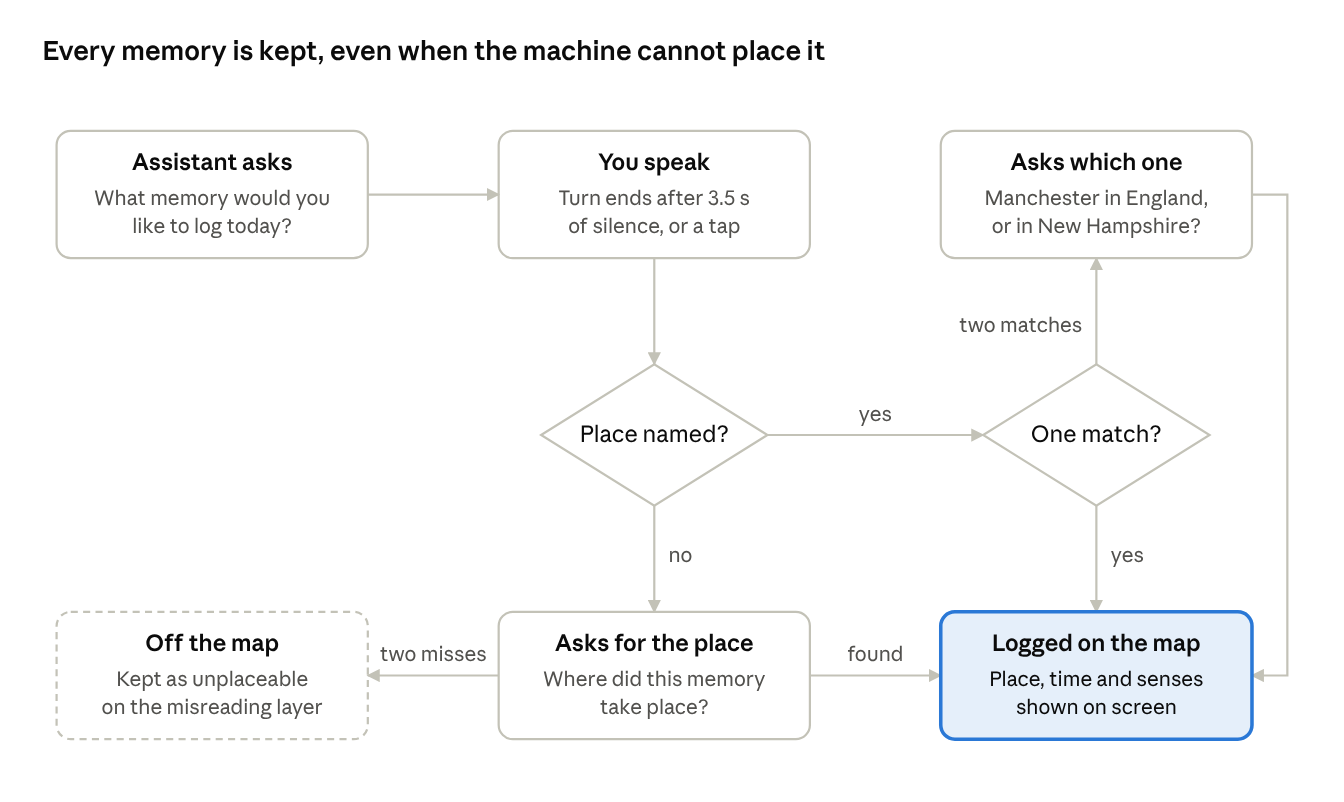
The conversation has one job: get a memory and a place, and never lose the memory if the place can’t be found.
I followed a standard conversation design process, adapted for an art piece: define the question the piece asks, write sample dialogs, read them aloud, map the flow with its error paths, then build and test.
The two questions. The assistant opens with “What memory would you like to log today?” and, if no place was mentioned, asks “Where did this memory take place?” Log is a surveyor’s word. It gives the machine a quiet character: it is trying to measure something that can’t be measured.
A sample dialog:
- Assistant: What memory would you like to log today?
- Me: The fog in winter, everything grey, and the sea so loud.
- Assistant: Where did this memory take place?
- Me: Barranco, in Lima.
- Assistant: Logged. Is there anything else you remember?
What the voice says and what the screen shows. The voice only speaks fixed lines. What the machine understood (place, time, senses) appears on screen and on the map instead of being read back. This kept the voice human, made it possible to record every line in advance, and keeps the machine’s reading visible as a separate layer.
Turn-taking for remembering. Voice systems are tuned for commands like “set a timer” and end your turn at the first short pause. Memories have long pauses. The assistant now waits 3.5 seconds of silence before replying (adjustable to 2 or 5), shows your words live as you speak, and lets you tap to finish early.
Mixed initiative. People often announce a memory before telling it: “I want to add a memory in Manchester.” The first version logged that sentence as the memory itself. Now an announcement sets the place, the assistant asks “What do you remember about it?”, and the next answer becomes the memory.
Misreadings as a map layer
The machine’s errors are part of the work, but they are kept on their own layer, sorted by type, like a layer in a GIS map.
In a product, a machine getting your memory wrong is unsettling. Leaving errors loose on the map would blur what the person said with what the machine guessed. Containing them in one switchable layer removes that fear: you can always see the two apart.
- Misheard. Speech recognition got a word wrong. Tagged by the person.
- Mislocated. The word was right, the place was wrong (the other Manchester). Tagged by the person.
- Unplaceable. The place couldn’t be found at all. Tagged automatically.
- Flattened. The place was caught, the senses were lost. Tagged automatically.
- Language switch. A word in another language broke recognition, like garúa, Lima’s winter mist. Tagged by the person.
Each type has its own symbol on the map. Memories that can’t be placed are never thrown away; they sit in a strip below the map labelled “off the map”. Those memories are where Debord’s idea and the machine’s limits meet most clearly.
The same thinking runs through my product work on Sanna, where I designed uncertainty flags and source references so teachers can see what an AI produced and how sure it is. Here the same principle is applied to memory instead of grading.
Desktop and mobile
I designed a desktop version to show the machine’s thinking and a mobile version for remembering on the move, which brings the piece closest to an actual dérive.
Desktop is a workbench. Beside the conversation, a readout shows what the machine is waiting for, what it heard and what it understood (intent, place, time, senses). The map switches between real geography and a memory layout where places spiral out in the order they were told. It can also listen for “I remember” without a tap.
Mobile is designed for one hand and divided attention:
- One large talk button where the thumb rests; settings, memories and the transcript open as sheets.
- The assistant’s question is large enough to read at a glance, and your words appear live as you speak.
- Tapping while the assistant speaks stops it and starts listening. Touch is the interruption.
- No wake word. Always-on listening in public, and the battery it drains, don’t suit a phone.
- The screen stays on during a session, because pauses in a memory are long. Locking the phone stops listening at once.
- The misreading layer and its legend live on the map, switched on by default.
What broke
Most of what I learned came from failures. Each one changed the design.
- The default browser voice felt scary asking for intimate memories. A synthetic voice and a personal request don’t mix; trust starts with the voice. I recorded every line with a warm ElevenLabs voice.
- The assistant cut me off mid-memory. Speech systems end a turn at the first pause; remembering is full of pauses. Now it waits 3.5 s of silence, shows a live transcript, and lets you tap to finish.
- “I want to add a memory in Manchester” was logged as the memory. People give the setting before the content. Now the announcement sets the place, and the memory comes next.
- Two lines came back in one recorded take. One generation with two sentences breaks turn-taking. Now it’s one line per recording.
- The microphone was blocked inside embedded and shared previews. Voice depends on where the page runs, not only on the design. Both versions now have a typed mode, and voice is tested on a hosted page.
- The assistant could hear itself. A turn-taking problem: its own voice was transcribed as mine. It never listens while speaking; on mobile, a tap interrupts.
Still to test with other people:
- Spanish place names inside English sentences (Barranco, Chorrillos).
- Whether the recognition confidence score is reliable enough to ask “Is that right?”
- Memories that are journeys between two places (“from Lima to Manchester”).
- Background noise outdoors on mobile.
Next
The next step is to let other people drift: test with three to five people who have lived in more than one country, with different accents and languages.
After that, two directions:
- Language model instead of a place list. The prototype only recognises a fixed list of places. A language model could locate a neighbourhood or a street, and would make different, more interesting mistakes.
- Exhibition. Visitors speak a memory of a place they left; the map collects everyone’s memories and misreadings into a shared atlas of displacement.
Sources
- Guy Debord, Theory of the Dérive, Les Lèvres nues 9 (1956), reprinted in Internationale Situationniste 2 (1958).
- Guy Debord and Asger Jorn, The Naked City (1957).
- Georges Perec, Species of Spaces (1974).