Close
An agent that checks payroll before it runs, and knows when to stop and ask.
Close is a fictional product. All data is synthetic.
- Built
- Autonomy rules, agent tools and guardrails, three desktop screens, replay demo
- In progress
- Live agent mode
- Next
- Trust testing with real and synthetic users
- ROLE
- AI Experience Designer
- YEAR
- 2026
- TYPE
- Agentic AI · Human-in-the-loop
- STATUS
- Work in progress
The problem
Payroll is high stakes and repetitive. An ops manager paying 80 people across several countries spends days cross-checking invoices, hours, contracts and local rules before every run. Most lines are fine. A few are not, and a single mistake means someone gets paid wrong.
An AI agent could do most of that checking. But it also needs to act on what it finds, not just flag it. That raises the real design question.
The question
How much should an agent be allowed to do on its own, and how does a person stay in control without re-checking everything?
Too little autonomy and the agent saves no time. Too much and people stop paying attention, until something goes wrong with someone’s salary.
My approach: risk decides autonomy
I didn’t give the agent one fixed level of independence. I designed an autonomy matrix where the risk of each issue sets what the agent may do:
- Low risk (a duplicate line, a date format): the agent fixes it, logs it, and allows undo for 24 hours.
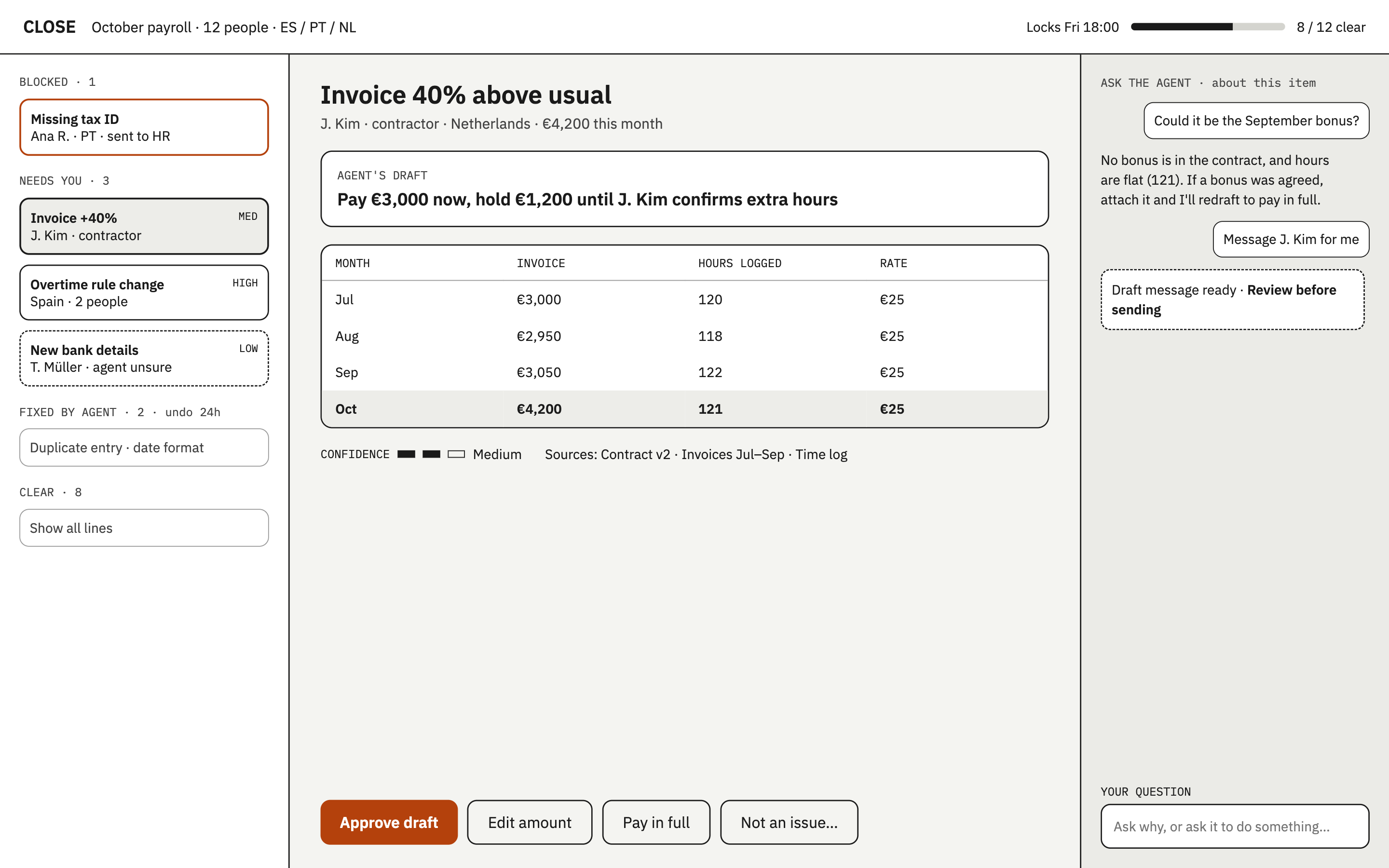
- Medium and high risk (an invoice 40% above usual, a new overtime rule): the agent drafts a fix with its reasoning, confidence and sources. A person approves.
- Blocked (a missing tax ID, changed bank details): the agent won’t act. It explains why and routes the item to the right person.
The key decision: these rules live in the system, not in the agent’s instructions. If the agent tries to pay someone without approval, the system refuses, and the attempt shows up in the interface. Trust shouldn’t depend on the model behaving well.
Designing the surface
My first sketches were mobile. I dropped that quickly: payroll review is desk work. People compare months side by side, read contracts and cross-check tables. So Close is desktop-first:
- Review workspace: issues grouped by risk, each with the agent’s draft, a history table, confidence and sources, plus a side panel to ask the agent why.
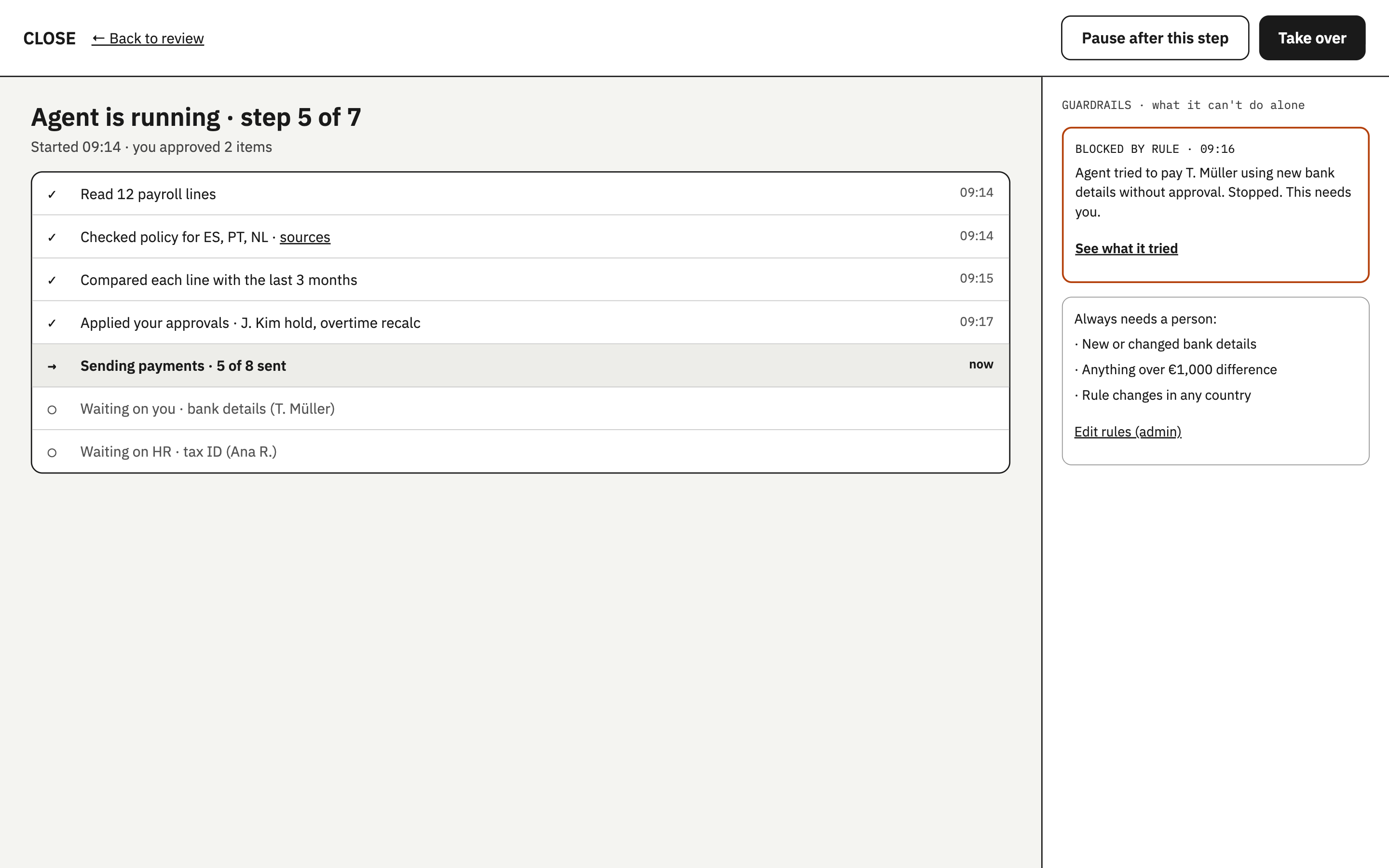
- Agent run: a step-by-step feed of what the agent did, what it’s doing, and what it’s waiting on. People can pause it or take over at any point.
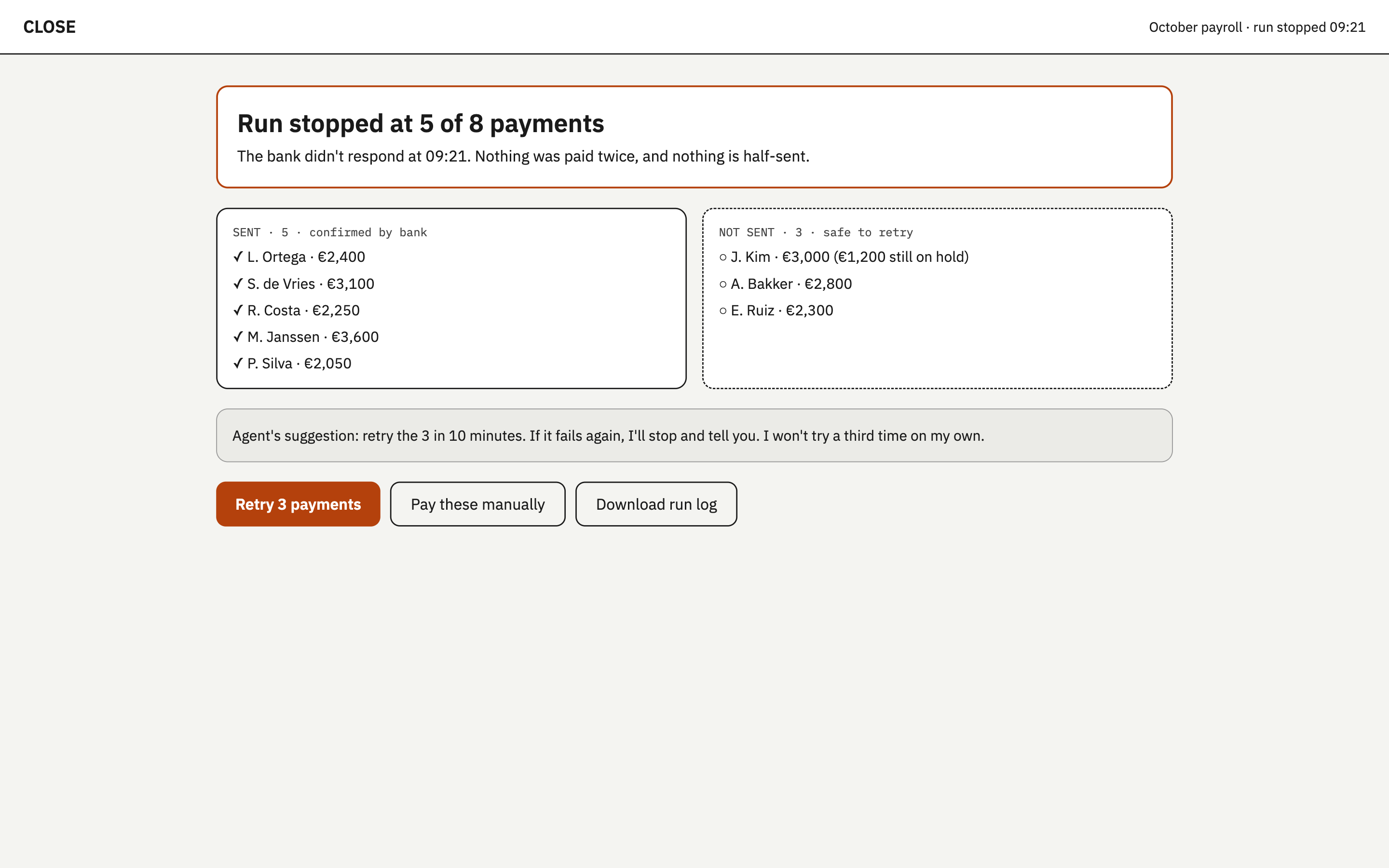
- Recovery: when a run fails halfway, it shows exactly what was paid and what wasn’t, so nobody has to guess.
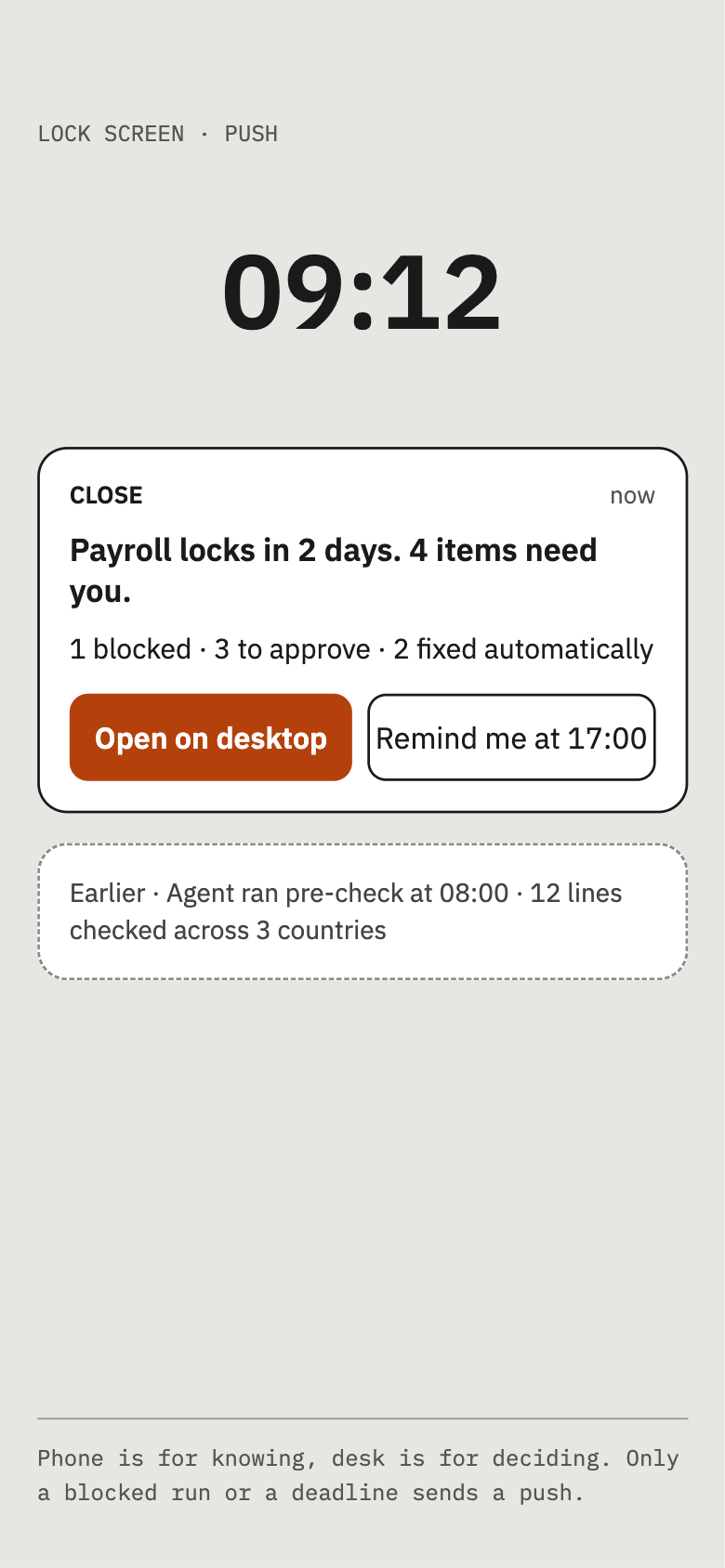
The phone only alerts. Phone is for knowing, desk is for deciding.
Designing for things going wrong
Agents fail in new ways, so I designed the error paths before the happy path:
- The agent is wrong → “Not an issue”, with a reason it learns from.
- The agent is unsure → it asks a question instead of acting.
- The agent oversteps → it gets blocked by a rule, and the attempt is visible.
- The run fails halfway → a clear sent / not sent state, and safe retry.
- The rules change → it cites the date of the policy it used.
How I’m building it
I wrote a one-page spec and built the prototype with Claude Code, from synthetic data to working screens. The public demo replays recorded agent runs, so it behaves the same way every time and needs no API key. A private live mode runs the real agent for test sessions.
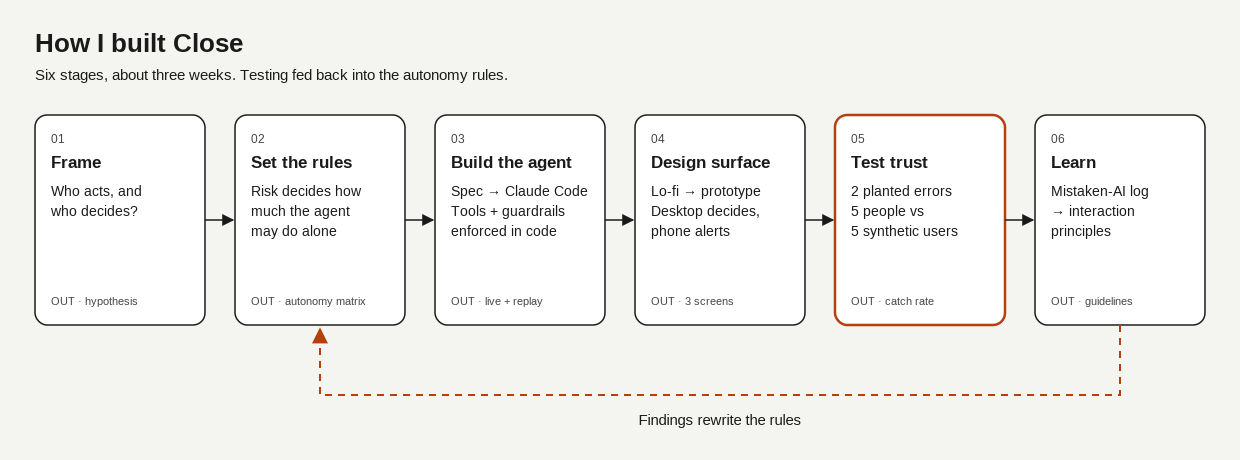
What’s next: testing trust, not usability
The test I’m running isn’t “can people use it?” but “do people trust it the right amount?”
- I’ll plant two wrong agent suggestions among correct ones.
- Do people catch them, or approve them without looking (over-trust)?
- Do they re-check everything by hand anyway (under-trust)?
- Does seeing the agent’s reasoning change either?
I’ll run the same test with five real participants from ops and finance, and five synthetic users, then compare where they differ. Every agent mistake goes into a “mistaken AI” log, which will become a set of interaction principles for agentic products.
Where this comes from
At Sanna, I designed AI transparency for teachers: labels for AI-generated content, per-criterion reasoning in grading, uncertainty flags, and the principle that the teacher makes the final decision. Close takes those patterns to a riskier domain, where the AI doesn’t only suggest but also acts.